

In Bangladesh cricket, the Under-19 setup has consistently served as a key platform for identifying future talents. However, for many promising cricketers, the more challenging journey often begins once they leave that bubble.
In the general scenario a player has to advance through age-levels to find his spot in the High Performance or Bangladesh A team before they can advance to the national team.
But as there are no conventional age-group steps between U-23 cricket and the Bangladesh national team, the players often find them on an uncharted pathway.
The inaugural Game Development Trophy, featuring three age-level teams U-17, U-19 and U-23, was organised to identify young talents, but the tournament also revealed another question: what happens to players once they leave the system?
The three-team tournament showed a wide gulf between the youngest players and their older counterparts. But there was little to separate the U-19 and U-23 teams.
It also exposed a crucial point in the development pathway.
For a player leaving the U-19 setup, therefore, the U-23s represent more than another age category. It is effectively the final developmental bridge before the senior game.
According to those working within Bangladesh’s age-group cricket, that transition could be the most important step before a player reaches the national team.
‘The Under-19 team always does well, but the Under-23 level is the most important stage before players move into the national team,’ said U-19 head coach Hannan Sarkar after the tournament.
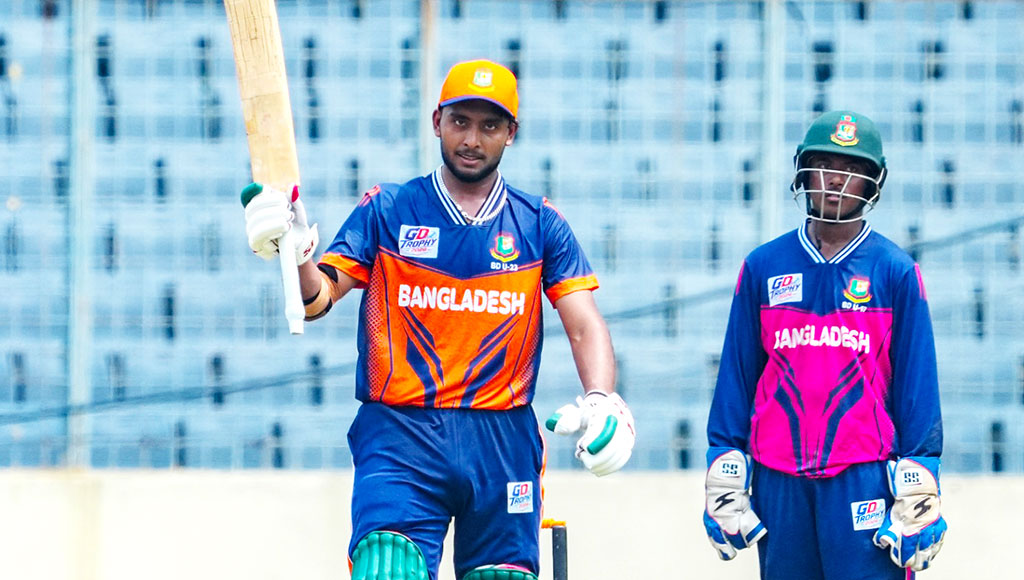
The U-23 left-handed batter, Md Abdullah, has experienced that transition over the past year.
The batter moved from the U-19 setup into the Dhaka Premier League before earning a call-up to the Emerging team. He then played against Malaysia with the U-23 side, toured South Africa and scored a century in the GD Trophy and emerged as the highest run-scorer for his side.
Now preparing for the National Cricket League with Barishal, Abdullah believes the jump from U-19 to U-23 is where young players are forced to change their approach.
‘The Under-19s has a unique charm because it’s the final age-group tier. The feeling as a player there is special,’ Abdullah told New Age.
‘The Under-23 level is naturally different. You’re playing with seniors, and the level is definitely higher, which is how it should be.’
Abdullah said in the U-19s, players are still being given space to develop, but in the U-23s, they are increasingly expected to perform while learning.
‘Often, if players fail to perform at the U-23 level, they struggle to advance to the next stage. So you have to embrace the challenge.’
That is why the gap between the two age groups matters even when their playing standards appear close.
The GD Trophy illustrated that point. The U-19s defeated the U-23s in the group stage and went on to win the tournament after rain washed out the final, with their higher position in the points table deciding the title.
The result indicated that the best U-19 players are already capable of competing against older opponents. But the challenge is whether they can sustain that level as they move into more demanding domestic cricket.
For Abdullah, the transition has required him to move quickly through several levels. He thinks the HP programme, meanwhile, could provide the next crucial link. However, the platform only provides space to only a handful of cricketers.
‘Right now, before the national team, there is the HP unit,’ Abdullah said.
‘To my knowledge, HP is the stepping stone right below the national team, so I want to prepare myself for that level. Nothing comes easily,’ he said.
Bangladesh does not only need to find its next generation. It needs to make sure they successfully survive the most difficult step that comes next.