

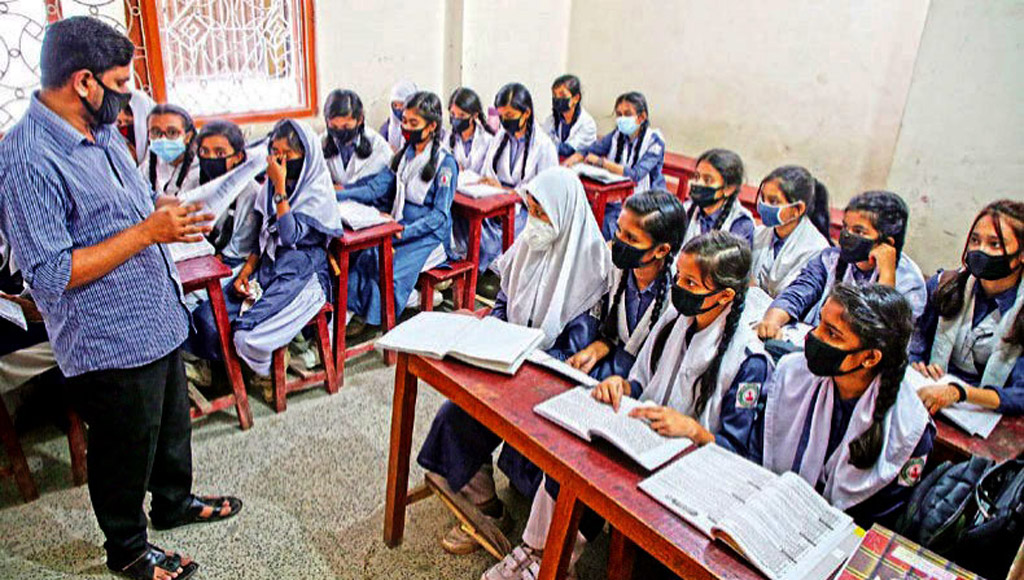
The proportion of trained teachers in secondary schools and madrassahs has declined despite an increase in the number of teachers, raising concerns about the quality of education.
The decline was particularly sharp in secondary schools, where the share of trained teachers fell to 59.48 per cent in 2025 from 66.1 per cent in 2024, 71.86 per cent in 2023 and 75.36 per cent in 2011, according to the Bangladesh Education Statistics 2024 released recently by the Bangladesh Bureau of Educational Information and Statistics.
The number of secondary-level teachers, however, increased to 3,04,646 in 2025 from 2,93,289 in 2024 and 2,78,518 in 2023.
Of the total teachers in 2025, 1,81,203, or 59.48 per cent, were trained. In 2011, 1,68,472, or 75.36 per cent, of 2,23,555 teachers had received training.
The situation was worse among female teachers. Of the 99,016 female secondary teachers in 2025, only 52,270, or 52.79 per cent, were trained. The rate was 60 per cent in 2024, 68.26 per cent in 2023 and 77.43 per cent in 2011.
The madrassah sector also saw a low proportion of trained teachers. Of 1,38,675 madrassah teachers in 2025, only 14,700, or 10.6 per cent, were trained. The proportion was 9.19 per cent in 2024, 27.69 per cent in 2023 and 24.48 per cent in 2011.
Among female madrassah teachers, only 2,795, or 9 per cent, of 31,050 were trained in 2025. The rate was 8.25 per cent in 2024, 30.11 per cent in 2023 and 37.66 per cent in 2011.
Educationists said that the growing number of untrained teachers could undermine efforts to improve the quality of education and achieve Sustainable Development Goal 4, which aims to ensure inclusive and equitable quality education by 2030.
They also questioned the effectiveness of existing teacher-training programmes in improving classroom teaching.
BRAC University Professor Emeritus Manzoor Ahmed said that teacher training was largely conducted under different projects and called for a permanent training programme.
‘A major concern is whether teachers become more qualified after getting the training,’ he said, stressing the importance of trained teachers in improving education quality.
Dhaka University Institute of Education and Research Professor Mohammad Ali Zinnah said that teacher training declined as education stakeholders became more focused on political activities than quality education towards the end of the Awami League regime.
After the 2024 political transition, the interim government also failed to undertake large-scale training initiatives, he said.
Teacher training had also declined after the Covid pandemic, while political unrest in 2024 created a further gap, educationists said. During the period, newly recruited teachers did not receive training while trained teachers continued to retire.
Zinnah said that improving education quality required not only properly trained teachers but also a student-friendly learning environment, adequate teachers and improved infrastructure.
The Bangladesh Bureau of Educational Information and Statistics has no data on trained teachers in colleges. It also has no updated statistics on qawmi madrassahs, as they are not registered with the government.
According to the Directorate of Secondary and Higher Education, there are 14 government teachers’ training colleges and five higher secondary-level teachers’ training institutes in the country.
The Bangladesh Madrassah Teachers’ Training Institute under the Directorate of Madrassah Education provides training to madrassah teachers, while the National Academy for Educational Management also conducts teacher-training programmes.